
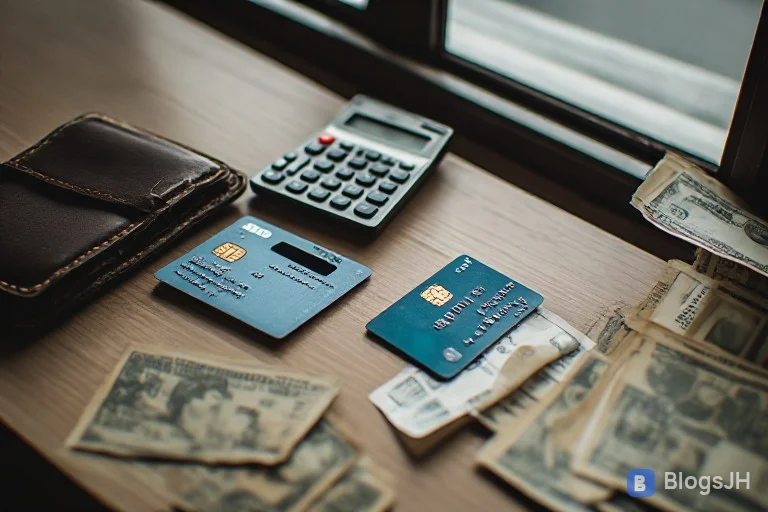
The Fundamental Difference: Whose Money Are You Spending?
This is the most important distinction:
Debit Card: You spend your own money — funds directly debited from your bank account. If you have ₹10,000 in your account, you can spend up to ₹10,000.
Credit Card: You spend the bank's money — a short-term loan that you must repay. You get a credit limit (say ₹1,00,000) and a billing cycle, and you pay the bill at the end of each month.
This single difference cascades into dozens of others: in fees, rewards, consumer protection, risk, and financial discipline.
Debit Cards: Advantages and Disadvantages
Advantages of Debit Cards
Spend only what you have: Impossible to go into debt (unless you have an overdraft facility). Ideal for those still developing financial discipline.
No interest charges: Since you're spending your own money, there is no interest to worry about.
Widely accepted: Accepted at virtually all ATMs, merchants, and online portals in India.
Easy to get: Every savings account in India comes with a debit card automatically.
UPI integration: Many debit cards link to your UPI ID (via apps like BHIM, PhonePe, Google Pay), making digital payments seamless.
Disadvantages of Debit Cards
Limited fraud protection: If your debit card is compromised and money is stolen from your account, recovering it can be difficult and time-consuming. Your money is gone immediately.
No rewards or benefits: Most standard debit cards in India offer little to no cashback, air miles, or lifestyle rewards compared to credit cards.
No credit history building: Using a debit card does not contribute to your CIBIL score or credit history.
No credit period: You pay immediately — there's no free credit period to defer a purchase.
Credit Cards: Advantages and Disadvantages
Advantages of Credit Cards
Interest-free credit period: You get 20–50 days (depending on your billing cycle) to pay for your purchases without any interest if you pay the full bill on time.
Rewards and cashback: Credit cards in India offer significant rewards — cashback (1–5%), reward points, air miles, lounge access, and discounts on dining, shopping, travel, and fuel. Premium cards like HDFC Infinia, Axis Magnus, or SBI SimplyCLICK can return significant value.
Consumer protection: Most credit card issuers offer zero-liability protection against fraud. If your card is misused, the bank typically reverses the transaction after verification.
EMI options: Large purchases can be converted to EMIs, making high-value buys more manageable.
Credit score building: Responsible credit card use is one of the best ways to build a healthy CIBIL score, which affects your loan eligibility and interest rates.
Insurance and purchase protection: Many premium cards offer travel insurance, purchase protection, and other perks.
Disadvantages of Credit Cards
High interest if misused: If you don't pay the full bill on time, interest rates kick in at 24–48% per annum — among the most expensive forms of debt.
Temptation to overspend: The "spend now, pay later" model can lead to overspending beyond your means.
Annual fees: Many good credit cards charge annual fees ranging from ₹500 to ₹10,000, though many waive these if you meet spending thresholds.
Debt spiral risk: Paying only the minimum due (not the full amount) triggers hefty interest on the remaining balance — a trap that can spiral into unmanageable debt.
Credit Card vs Debit Card: Head-to-Head Comparison
Feature | Credit Card | Debit Card |
|---|---|---|
Whose money? | Bank's (borrowed) | Yours |
Interest risk | High (if unpaid) | None |
Rewards and cashback | Excellent | Minimal |
Fraud protection | Strong | Weak |
Credit score impact | Positive (if used well) | None |
Overspending risk | High | Low |
Ease of getting | Requires income/eligibility | Automatic with account |
Annual fees | Often (some free) | Usually free |
EMI facility | Yes | Limited |
International use | Widely accepted | Limited (some restrictions) |
When to Use Your Debit Card
At ATMs for cash withdrawals
For small daily purchases if you're prone to overspending on credit
When shopping at merchants that don't accept credit cards or charge a surcharge
When you're early in your financial journey and still building discipline
For UPI payments (linked to bank account)
When to Use Your Credit Card
For all major online purchases (better fraud protection)
For travel bookings — flights, hotels, travel insurance coverage
For dining, fuel, and categories where your card offers high cashback
For large purchases you'll convert to EMI
Anytime you'd earn significant rewards on your spending
The Golden Rule of Credit Cards: Never spend more on a credit card than you already have in your bank account to pay it off. Treat it as a debit card with rewards — spend what you have, pay the bill in full every month.
The CIBIL Score Angle
Your CIBIL score (credit score) is a three-digit number between 300 and 900 that determines your creditworthiness for loans. Responsible credit card use — paying bills on time, keeping utilisation below 30%, not maxing out limits — actively builds your CIBIL score. A strong score (750+) can get you home loans and car loans at significantly lower interest rates, saving you lakhs over the loan tenure.
Which Is Better Overall?
For financially disciplined individuals who pay their full bill every month, a credit card offers significantly more value than a debit card for most spending categories. You earn rewards, get fraud protection, build credit history, and get an interest-free credit period — all for free if you manage it responsibly.
For those who struggle with impulse control or tend to carry a balance, a debit card is safer — it prevents debt accumulation and keeps spending grounded in reality.
Understanding Credit Score Weightage and CIBIL Impact
Your credit score is not an arbitrary number; it is derived from mathematical scoring algorithms calibrated by credit bureaus like TransUnion CIBIL, Experian, CRIF High Mark, and Equifax. When evaluating your profile for premium cards or home mortgages, lenders look at specific behavioral metrics:
CIBIL Scoring Pillar | Relative Weightage | Optimal User Behavior |
|---|---|---|
Payment History | 35% | 100% on-time full bill settlement; never settle for minimum due |
Credit Utilization Ratio (CUR) | 30% | Keep aggregate balances below 30% of your sanction limit across all cards |
Credit History Age | 15% | Keep your oldest active credit card open to preserve long-term track record |
Credit Mix | 10% | Maintain a healthy balance between secured debt (home/auto) and unsecured lines |
Hard Inquiries | 10% | Space out new loan/credit card applications by at least 6 months to avoid looking credit-hungry |
Hidden Credit Card Charges to Watch Out For
While credit cards provide unparalleled convenience and rewards, card issuers generate significant revenue through fees that unwary consumers often overlook:
Foreign Currency Markup: When making purchases in foreign currencies (including foreign online merchants), banks typically charge a 1.5% to 3.5% forex markup fee plus 18% GST.
ATM Cash Advance Fee: Withdrawing cash from an ATM using a credit card attracts an immediate transaction fee (usually 2.5% to 3%) and starts accruing daily interest immediately without any interest-free window.
Over-Limit Penalty: If a scheduled charge pushes your balance above your credit limit, issuers can levy penalties up to ₹500 or 2.5% of the overage amount.
Late Payment Fee Slabs: Missing a payment deadline triggers graded penalties depending on your balance, alongside a sharp drop in your CIBIL score.
Conclusion
The debit vs credit card debate has no one-size-fits-all answer. The right choice depends on your self-discipline and financial goals. If you can commit to paying your credit card bill in full every single month, a rewards credit card is an excellent financial tool. If you're still building that discipline, start with your debit card and use credit sparingly. Many savvy Indians use both strategically — credit cards for reward-earning categories, debit cards for ATM withdrawals and situations where credit isn't appropriate.


Join the Conversation
0 CommentsNo comments yet
Be the first to share your thoughts and start the discussion.