
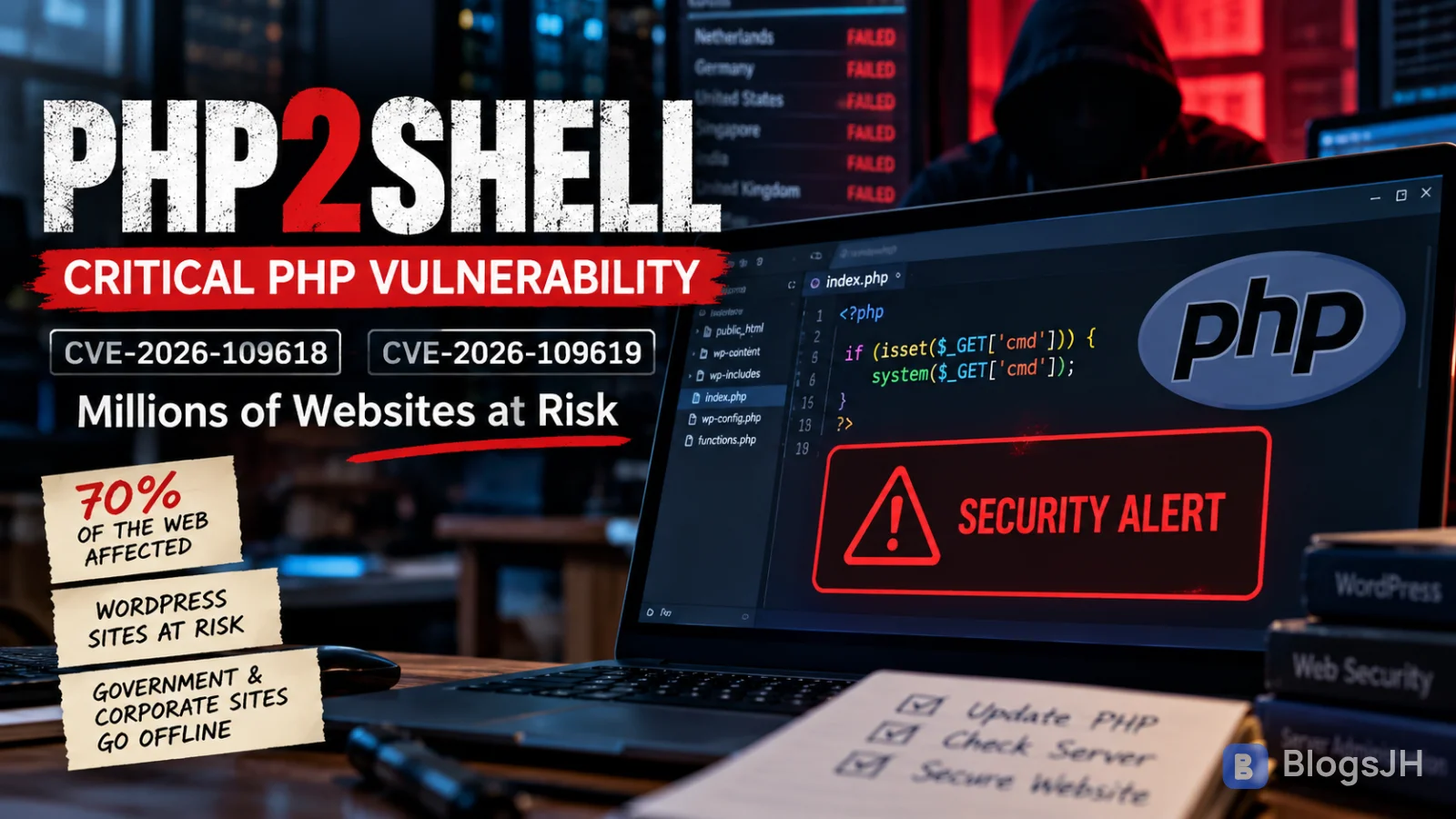
What Is PHP2Shell?
PHP is a server-side programming language used to build dynamic websites and web applications. It powers major platforms, including WordPress, as well as countless custom websites, business systems and online services.
On October 21, 2026, PHP maintainers released emergency security updates addressing two critical vulnerabilities. Each received a CVSS v4.0 severity score of 9.2 out of 10.
The flaws were assigned these identifiers:
CVE-2026-109618: Remote code execution associated with out-of-memory corruption.
CVE-2026-109619: Remote code execution associated with stale internal state.
Both vulnerabilities affect PHP itself, rather than a specific WordPress plugin or website theme. That distinction matters. Updating a plugin alone cannot fix a flaw in the underlying PHP runtime.
According to the PHP Foundation and security advisories, the vulnerabilities can allow an unauthenticated attacker to execute code under certain conditions. Depending on the server configuration and privileges, successful exploitation could compromise an application or expose sensitive information.
Why Is This Vulnerability So Serious?
The central concern is the position PHP occupies in the web ecosystem.
PHP runs on a substantial share of websites worldwide. WordPress, Drupal, Joomla and custom applications can all rely on it. A flaw in the language runtime can therefore affect many different products at once.
However, PHP usage does not mean every website is automatically exploitable. Actual risk depends on the PHP version, server configuration, request-handling environment and whether a vendor has applied the relevant fixes.
The first vulnerability involves memory allocation failure during request processing. In simple terms, PHP can encounter an error while preparing internal data, then attempt to clean up information that was never fully initialized.
The second concerns stale internal state. Information associated with an earlier request can remain referenced after its memory has been released. If a later request uses that outdated state, the process may behave unpredictably and potentially become vulnerable to code execution.
These are difficult classes of software defects to identify through ordinary application testing. They exist in the engine that processes requests, making the consequences potentially broader than a flaw confined to one application.
Government and Corporate Websites Go Offline
The security response quickly moved beyond routine patch announcements.
Reuters reported that government and public-facing services in several European countries were taken offline as a precaution. In the Netherlands, affected services included government portals and websites associated with the Port of Rotterdam, political parties, the national football association and hospitals.
The Dutch National Cyber Security Centre also took its website offline temporarily. Wikipedia and the Internet Archive reported taking some systems offline while they addressed the issue.
These actions were precautionary security measures, not proof that every affected organisation had been breached. For some operators, temporarily restricting public access was a way to reduce exposure while updates and checks were carried out.
The incident also demonstrated how a vulnerability in shared infrastructure can create a chain reaction. One software component may underpin thousands of applications, and administrators cannot always establish their exposure immediately.
Security researchers also reported exploitation attempts before and after public disclosure. Amazon Threat Intelligence reportedly detected an attempt on a honeypot on October 17, before the official patch release. This is evidence of attempted exploitation, not by itself proof of widespread successful compromise.
How AI Helped Find Long-Hidden Vulnerabilities
One of the most significant aspects of PHP2Shell is the role of AI-assisted security research.
OpenAI described the response as part of Patch the Planet, an initiative focused on using advanced AI systems to identify vulnerabilities and coordinate with software maintainers and security partners.
According to OpenAI, the security research firm Calif used GPT-5.6 Sol to identify a critical flaw. OpenAI also reported the issue independently. Wiz separately investigated PHP and reported findings using its Wiz Atlas research tool alongside AI models, including Gemini 4 Argon and GPT-5.6 Sol.
The work was not simply a chatbot reading a file and declaring it unsafe. Vulnerability research involves understanding complex code paths, examining how software behaves when errors occur, validating hypotheses and testing whether a proposed fix actually closes the problem.
AI tools can help researchers explore large codebases, identify suspicious relationships between components and accelerate analysis. Human researchers and maintainers remain essential for validating findings, assessing real-world impact and producing reliable patches.
The PHP Foundation said the underlying memory-management problem had been considered earlier, but the new research clarified its severity and the ways it could be exploited. The episode shows how AI-assisted analysis can uncover consequences that are difficult to see during conventional review.
The Double-Edged Sword of AI in Cybersecurity
AI can help defenders discover weaknesses before attackers exploit them. That creates a valuable window in which maintainers can prepare patches, hosting companies can deploy protections, and organisations can update exposed systems.
But the same general capabilities can also benefit attackers.
AI can accelerate code analysis, help interpret public technical disclosures and reduce the time needed to understand a newly patched flaw. Once details become public, attackers may race to identify systems that have not yet been updated.
This does not mean AI automatically makes every attack successful. Real exploitation still depends on technical conditions, target configuration and the attacker's capabilities. But shorter discovery and development cycles make rapid patching and monitoring more important than ever.
PHP2Shell is therefore not simply a story about AI finding bugs. It is a case study in how quickly defenders must respond when powerful analysis tools meet widely deployed software.
How to Protect a PHP Website
The PHP project released fixes on October 21, 2026. Administrators should check the official advisory and their operating system or hosting provider's guidance.
The relevant fixed PHP releases are:
PHP 8.5.12
PHP 8.4.27
PHP 8.3.36
PHP 8.2.35
Use the fixed release for your supported branch, or a vendor package that includes the security fix. Older PHP branches may be unsupported by the PHP project; some vendors provide backported patches, so verify the status of your specific package.
Website owners should:
Confirm the PHP runtime. Check the version used by the actual production server, not just a local development environment.
Apply the security update. If a hosting provider manages PHP, ask it to confirm that the relevant fix has been installed.
Check bundled software. Containers, control panels, appliances and managed products may include their own PHP runtime.
Review logs and alerts. Investigate suspicious request patterns, unexpected processes, memory errors and other anomalies around the disclosure period.
Use temporary protections where needed. A suitable web application firewall or access restriction can reduce exposure while patching is arranged, but it is not a substitute for the runtime update.
Follow incident-response procedures. If there are signs of compromise, preserve relevant logs and involve qualified security staff before assuming that patching alone has resolved the incident.
Cloudflare reported deploying protective web application firewall measures before public disclosure. Such controls can add a layer of defence, but organisations should still install the official fix.
Conclusion: A Wake-Up Call for the Web
PHP2Shell illustrates the risks created by vulnerabilities in foundational software. A flaw in a widely deployed runtime can affect websites across industries, force temporary shutdowns and create urgent work for administrators who may not control every component in their technology stack.
It also shows AI's growing influence on security research. The same class of tools can help uncover serious weaknesses and, in the wrong hands, accelerate attempts to exploit them.
For website operators, the immediate lesson is practical: identify the PHP runtime, apply the appropriate fix, verify third-party components and investigate suspicious activity. For the wider industry, the challenge is to turn faster discovery into faster, safer remediation.
PHP2Shell at a Glance
Area | Key details |
|---|---|
Vulnerability name | PHP2Shell |
CVE identifiers | CVE-2026-109618 and CVE-2026-109619 |
Severity | CVSS v4.0: 9.2/10 each |
Main risk | Potential unauthenticated remote code execution under applicable conditions |
Affected technology | PHP runtime and products that bundle affected PHP versions |
AI research | Calif, OpenAI and Wiz reported AI-assisted vulnerability research |
Fixed releases | PHP 8.5.12, 8.4.27, 8.3.36 and 8.2.35 |
Recommended response | Update the runtime, check vendor packages and investigate suspicious activity |


Join the Conversation
0 CommentsNo comments yet
Be the first to share your thoughts and start the discussion.