
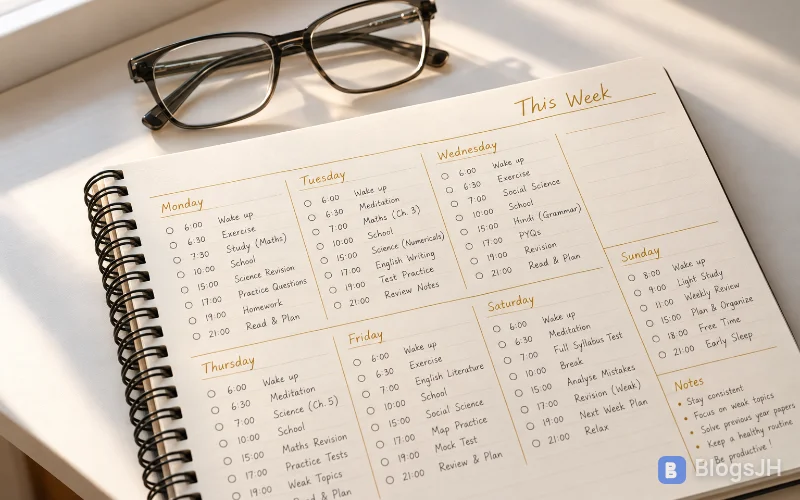
Thirty days can make a meaningful difference to your exam preparation, provided you use your time carefully. Whether you are preparing for school examinations, board exams, or college tests, the challenge is usually the same: completing the syllabus, remembering what you have studied, practicing questions, and managing your remaining time.
The solution is not necessarily to study for ten or twelve hours every day. Instead, build a plan around your current preparation level, prioritize important topics, test yourself regularly, and leave enough time to correct mistakes.
This guide provides a practical, day-by-day 30-day exam preparation plan that you can adapt to your syllabus and daily routine.
Can You Prepare for Exams in 30 Days?
Yes, you can improve your preparation significantly in 30 days. However, completing an entire syllabus from scratch is different from revising material you have already studied.
Your results will depend on factors such as:
How much of the syllabus you have already covered.
The difficulty and length of your subjects.
The time available each day.
Your understanding of the concepts.
How effectively you practice and review mistakes.
If you have already studied most chapters, focus on revision, past papers, and mock tests. If several chapters are still untouched, prioritize essential concepts and frequently assessed topics while continuing to practice questions.
Remember: No study plan can guarantee a particular percentage or rank. The purpose of a 30-day plan is to use your remaining time more effectively.
Step 1: Assess Your Syllabus Before Starting
Before making a timetable, spend the first part of Day 1 reviewing your syllabus, examination pattern, and available study materials.
Divide your chapters into three categories:
Category | Current preparation | What to do |
|---|---|---|
A | Important and weak | Give these topics priority |
B | Partly understood | Revise and solve questions |
C | Well understood | Review periodically and test yourself |
You should also identify topics that carry significant marks according to your official syllabus, sample papers, or previous examination papers. Do not assume that a topic will appear simply because it appeared in an earlier paper.
Create a checklist of chapters for every subject. Estimate how long each chapter will take and mark the topics that need the most attention.
This simple audit helps you avoid spending too much time on familiar material while leaving difficult chapters until the final week.
The 30-Day Exam Preparation Plan
The plan is divided into four phases:
Days 1–10: Organise your preparation and cover priority topics.
Days 11–18: Complete remaining essential material and strengthen understanding.
Days 19–24: Revise the syllabus and practice examination questions.
Days 25–30: Attempt mock tests, analyse mistakes, and prepare for the exam.
Adjust the pace to match your syllabus. If your preparation is already advanced, begin timed papers earlier. If you are starting from scratch, concentrate on the most important foundational topics first.
Days 1–10: Build Your Foundation
Day 1: Analyse the syllabus
List every subject and chapter. Identify your strongest and weakest areas, collect official sample papers and previous-year questions, and create a realistic daily schedule.
Day 2: Start with a high-priority weak topic
Choose an important chapter that you find difficult. Study its main concepts, work through examples, and solve a small set of questions without looking at the solutions immediately.
Day 3: Cover another priority topic
Continue with a weak or important topic from the same subject or another subject. Spend some time recalling the material studied on Day 2.
Day 4: Strengthen a problem-solving subject
For subjects such as mathematics, physics, or accounting, practice questions step by step. Write down the reason for each error, including conceptual mistakes, calculation errors, and incorrect methods.
Day 5: Study a theory-heavy subject
Focus on understanding key concepts, definitions, dates, processes, diagrams, or arguments as required by your syllabus. Close the book and write down what you remember before checking your notes.
Day 6: Review earlier topics
Revisit the material from Days 2–5. Attempt short questions or flashcards and solve a few questions without using notes. Return to any concept you cannot explain clearly.
Day 7: Check your progress
Take a short, timed test covering the topics studied during the first week. Review your answers and identify the three most important weaknesses to address next.
Day 8: Work on the biggest remaining gap
Choose one of the weaknesses identified on Day 7. Review the relevant concepts, solve representative questions, and check your understanding.
Day 9: Cover another important chapter
Continue syllabus coverage, focusing on a topic that is important but not yet secure. Avoid spending the entire session creating elaborate notes.
Day 10: Complete a 10-day review
Review your chapter checklist. Mark what is complete, partly understood, and still untouched. Adjust the remaining schedule based on actual progress rather than forcing yourself to follow an unrealistic plan.
Days 11–18: Complete Essential Material and Practice
Day 11: Finish a priority chapter
Work through an important unfinished chapter. Focus on the learning objectives, core concepts, examples, and questions relevant to your examination.
Day 12: Practice application-based questions
Solve numerical problems, case-based questions, structured answers, or other question types used in your exam. Identify whether your mistakes come from weak understanding or difficulty applying what you know.
Day 13: Cover another unfinished topic
Choose the next priority chapter. If a full chapter is too large, divide it into smaller sections and complete the most important foundations first.
Day 14: Take a topic-wise test
Attempt questions from several chapters already studied. Use a time limit and check your answers afterwards. Add recurring mistakes to a dedicated error log.
Day 15: Revise a second subject
Shift attention to another subject that needs improvement. Use active recall, worked examples, diagrams, or written answers depending on the type of material.
Day 16: Review difficult concepts
Return to topics that you repeatedly get wrong. Use your textbook or trusted learning materials to resolve the underlying confusion before attempting similar questions again.
Day 17: Practice previous-year questions
Solve selected previous-year questions or official sample-paper questions topic by topic. Look for recurring question formats, but do not assume that past questions will be repeated exactly.
Day 18: Check syllabus coverage
Review your checklist again. Complete any remaining essential material where feasible. If the syllabus is extensive, prioritize foundational and important topics instead of rushing through every chapter without understanding it.
Days 19–24: Revise and Apply Your Knowledge
Day 19: Revise Subject 1
Recall key ideas without looking at the book first. Then check your answers, revise weak points, and solve exam-style questions.
Day 20: Revise Subject 2
Use the same method for another subject. Include questions that require written explanations, calculations, diagrams, or other examination-specific skills.
Day 21: Attempt a timed paper
Choose a suitable sample paper or previous-year paper. Follow the official time limit as closely as possible and avoid checking answers while attempting it.
Day 22: Analyse the paper
Check the paper using an official marking scheme where available. Categorize lost marks into knowledge gaps, careless mistakes, time-management issues, and misunderstanding of questions. Practice the weakest question types.
Day 23: Revise Subject 3
Concentrate on important concepts and topics that still require work. Test yourself before reviewing the answers.
Day 24: Attempt another timed paper
Choose a different subject or paper. Compare your performance with your previous attempt, paying attention to accuracy, question selection, and completion within the time limit.
Days 25–30: Mock Tests and Final Revision
Day 25: Take a full mock test
Attempt a complete paper under examination-like conditions. Use the appropriate time limit, avoid interruptions, and answer questions independently.
Day 26: Correct your mistakes
Review the mock test carefully. Relearn the concepts behind incorrect answers and practice similar questions. Do not treat the score as the only measure of progress.
Day 27: Revise your weakest areas
Use your error log and chapter checklist to select the topics most likely to benefit from further work. Revisit formulas, definitions, diagrams, concepts, or answer structures as appropriate.
Day 28: Take another timed paper
Attempt another full paper if you have one available and enough time to review it. Otherwise, complete a timed section or a set of mixed questions from several topics.
Day 29: Conduct a focused revision
Review concise notes, formula sheets, flashcards, important definitions, and mistakes from previous tests. Avoid starting large new resources unless you need them to clarify an essential concept.
Day 30: Keep preparation light and organised
Review key points and check your examination requirements, such as the timetable, permitted stationery, and any instructions issued by your school or examination authority. Avoid an exhausting last-minute study marathon. Aim for a regular night's sleep.
If your exam starts before Day 30, move the final revision and rest period to the days immediately before the actual examination.
How Many Hours Should You Study Each Day?
There is no universal number of study hours that guarantees success. Your schedule should account for school, coaching, travel, homework, meals, rest, and your current level of preparation.
A practical starting point for a student who attends school could be two or three focused study blocks on a typical weekday, with longer practice sessions when time permits. Students with more available time may use additional blocks, provided they can maintain concentration and review what they learn.
For example:
Session | Suggested activity |
|---|---|
Block 1 | Learn or revise a difficult topic |
Block 2 | Solve questions from that topic |
Block 3 | Recall an earlier topic or review mistakes |
Try a 25-minute study session followed by a five-minute break, or a 45–50-minute session followed by a longer break. Choose a format that helps you remain focused.
Keep your plan flexible enough to accommodate unexpected work. A timetable that you can follow consistently is more useful than one that looks impressive but fails after two days.
Study Techniques That Make the 30 Days More Effective
1. Use active recall
Active recall means trying to retrieve information from memory before checking your notes. Close your textbook and explain a concept, write down key points, solve a problem, or answer a question.
This approach is more useful than relying entirely on repeated reading. A major review by Dunlosky and colleagues identified practice testing as a high-utility learning technique.
Read the research review: Improving Students' Learning With Effective Learning Techniques.
2. Space out revision
Do not revise a chapter only once and then leave it untouched until the exam. Return to important material over multiple days.
For example, you could study a topic on Day 2, recall it on Day 4, test it again on Day 7, and revisit it during your final revision. Adapt the intervals according to how well you remember it.
Research reviews identify distributed practice as another useful learning strategy.
3. Solve questions instead of only watching lectures
Lectures can help clarify unfamiliar concepts, but watching a video is not the same as being able to answer an examination question independently.
Use a lecture when you need an explanation, then return to your textbook, solve relevant questions, and check your understanding.
4. Maintain an error log
Create a notebook or document with three columns:
Question or topic | Why I made a mistake | What I will do next |
|---|---|---|
Formula-based problem | Used the wrong formula | Practice similar problems |
Long-answer question | Missed key points | Review the answer structure |
Concept question | Confused two ideas | Relearn and test both concepts |
Review this log regularly, especially during the final week. It helps you target recurring weaknesses instead of repeatedly practicing only what you already know.
How to Adapt the Plan if You Are Behind
If you have barely started, do not panic or try to copy a topper's schedule without considering your situation. Online discussions about last-minute preparation often recommend prioritizing important chapters, practicing exam-style answers, using past papers selectively, and making short revision maps. These are practical suggestions, not guarantees of a particular score.
Use this priority order:
Identify foundational concepts needed to understand other chapters.
Prioritize topics based on the official syllabus, exam pattern, and available sample papers.
Practice representative questions rather than completing every repetitive exercise.
Revisit topics where your mistakes show a genuine knowledge gap.
Keep some time for mixed questions and final revision.
If you are already well prepared, spend less time relearning familiar chapters and more time on timed papers, application questions, and weak areas.
If you are starting from scratch, you may not be able to master every topic in 30 days. A selective but structured plan is more realistic than rushing through the entire syllabus without testing yourself.
Common Mistakes to Avoid
Making an overloaded timetable: Too many daily targets make it difficult to maintain consistency.
Only reading notes: Familiarity with a page does not prove that you can recall its contents.
Ignoring past papers: You need to understand the question formats, instructions, and time limits used in your examination.
Taking mock tests without reviewing them: A test is an opportunity to discover and correct weaknesses.
Changing resources repeatedly: Use your prescribed textbook, official materials, and a limited number of reliable supplementary resources.
Ignoring rest: Sleep supports attention and learning. The CDC recommends 8–10 hours of sleep for teenagers aged 13–18.
Expecting instant results: Track completed topics, accuracy, and recurring mistakes rather than judging your preparation by one test alone.
For further guidance, see Cornell University's study schedule recommendations and the CDC's guidance on sleep for teenagers.
Final Thoughts
A 30-day exam preparation plan works best when it combines syllabus prioritization, regular revision, question practice, mock tests, and honest review of mistakes.
Start by understanding what remains to be done. Use the first part of the month to strengthen your foundations, the middle to practice and revise, and the final days to assess your readiness and correct weaknesses.
You do not need a perfect timetable. You need a realistic plan that you can follow, measure, and adjust as you learn more about your own progress.
Start today: list your subjects, mark your weakest important chapters, and choose the first study task you can complete in one focused session.



Join the Conversation
1 Comment